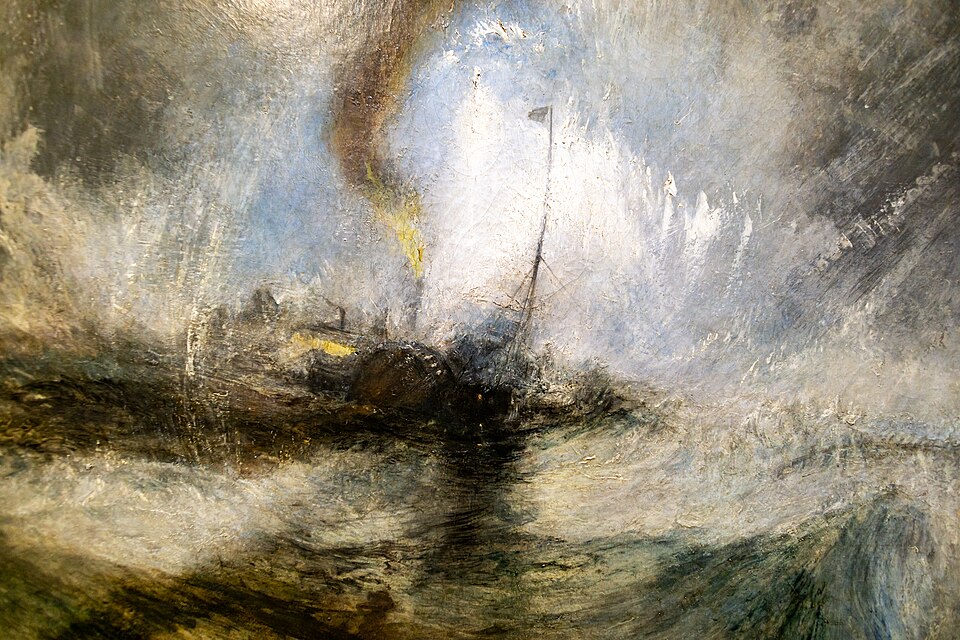
J.M.W. Turner, Steamboat off a Harbour´s Mouth, 1842.
Phenomenology of Disappearance (1)
Let us consider the concept of “disappearance.” When something disappears, this means that there is no longer a sensible perception of what has disappeared. For that very reason, it also means that this thing must previously have been an object of our perception. Disappearance therefore presupposes the presence of the object along a temporal line: within that temporal presence, a change occurs that leads it from being perceived to no longer being perceived.
The disappearance of physical and clearly identifiable objects offers us the most accessible example for understanding what disappearance generally means. To begin with, it is not enough for an object to cease being an object of my perception for it to be said to have disappeared. If I leave the space in which my table is located and no longer see it, I will certainly not become suddenly perplexed and claim that it has disappeared. It is I, together with my cognitive system, who have moved beyond the space in which the object can continue to be an object of my perception. The same applies if someone removes the object from my perceptual field. I understand that the table continues to exist in another space and, therefore, has not disappeared.
George Berkeley: to be is to be perceived
In the history of philosophy, an important moment for understanding the relationship between perception, the absence of perception, and appearance / disappearance is provided by the theory of George Berkeley (1685–1753), who was a bishop in Ireland. This fact is not trivial, since his entire conceptual horizon is tied to a theological vision of the world.
Berkeley famously formulates a principle: esse est percipi, “to be is to be perceived.” This principle is often misunderstood and abusively interpreted. The most straightforward reading would lead us to think that an object exists only insofar as it is perceived by a subject, and that when it is no longer perceived it ceases to exist, entering some kind of twilight zone from which it re-emerges the moment our perception falls upon it again. This is not what Berkeley intends to express. His argument is more subtle: the object—any object, any material existence—does not exist in itself, isolated from all perception; rather, it is perception itself that gives it being.
It may seem that this is merely another way of saying the same thing, but Berkeley states categorically that an object continues to exist so long as some perception of it, by any subject whatsoever, is possible. It is therefore not only the “I” who grants existence to the object through an individual act of perception (hence the object does not cease to exist if I do not perceive it), but rather the mere possibility of an object being an object for someone. An object exists insofar as a perception of it can exist. The existence of the object is given by its perceptibility for a mind. From this it follows that material existence, properly speaking and considered in itself, does not subsist on its own, with its own forces and nature, in the absence of a mind that perceives it: matter has no substance that sustains it outside perception.
The claim that existence depends on perception (esse est percipi) implies that it is perception as such — and not my perception, my mind, my experience of the object — that gives it existence. The most difficult point to grasp lies in the consideration that the object, once perceived, is translated into an idea, a representation, a memory. Now, since these are purely mental acts, and since we can only have experience of them insofar as we ourselves are the agents of these mental acts, it might seem that the entire external world would be reduced to my perception of it. But this is not the case, for Berkeley maintains that it is perception as such, and not my perception in particular, that is the condition for the existence of the object. In other words, the set of sensible data of something — forms, colours, tactile qualities, smells, sounds — is at the same time the totality of the object. Its appearance is its essence, and its essence is its existence as appearance.
Berkeley thus affirms that there exists a subject capable of continuously observing the world and all its contents, and that perception by this entity — God — secures the existence of what, at a given moment, is not an object of my perception. The object therefore does not disappear when my perception of it ceases, since there is an infinite and omniscient being who observes everything, an absolute subject, so to speak.
Berkeley’s argument provides a philosophical grounding for something that already appears to us, from the outset, as obvious and self-evident. It would be almost superfluous if it were merely a defence against solipsism, that is, against the idea that only the subject exists and nothing outside it. But this is not the case. What Berkeley seeks to bring into view is not the subsistence of the object when my perception no longer receives it, but rather the fact that the object is nothing outside perception, and that only through perception does the world become content of my consciousness. Berkeley’s response to what is, in reality, a metaphysical problem (what is the structure of reality? does anything exist beyond perception? what does my perception offer me of the reality of things?) reveals the relational character of his philosophy, in which the subject (the individual or, in his absence, God) and its perceptual field — that is, the experiential horizon in its entirety — coincide with reality. There is no proper “manifestation” of reality, for this would presuppose an “unmanifested” state. There is no essence behind mere appearance, since appearance itself constitutes the essence of reality.
This is therefore an argument in favour of empiricism, and anti-isolationist with regard to the condition of the subject in the world.
Perception and Disappearance
What Berkeley seeks to bring into focus, then, is the non-existence of a material substance in the world that would be independent of our mind and of our perceptions. In doing so, he touches directly upon the theme of disappearance, since he not only defends the continuity of existence beyond my own perception, but also raises the question of the very material nature of things: in what sense they can be said to have disappeared, and in what sense—if their existence is entirely identifiable with perception—the very understanding of what perception is can decisively influence the precise way in which something is considered to have disappeared.
Visual perception can be characterised in a way that is relatively easy for us to grasp. It requires light and matter. The formal aspects of matter are then transmitted to our gaze, which distinguishes shape, colour, and volume. The moment in which this encounter between object and visual perception takes place can be described as a presence, an appearance. Perception through the other sensory organs is likewise involves an appearance, although the formal aspects of the contact between object and sensory organ are different (touch, smell, sound).
In this way, disappearance must necessarily be understood not as absolute absence, but as the absence of something that was previously, and effectively, present within the field of experience. Added to this condition is the need for a before and an after, and therefore for changes to occur within the field of experience over a given span of time.
As Berkeley tells us, the fact that I cease to perceive an object does not mean that it ceases to exist, nor that it ceases to be perceptible. As long as the object remains perceptible, in the sense that it can continue to be perceived by some subject whatsoever, it cannot, in general terms, be said to have disappeared. An object that has disappeared for all subjects, however, brings us closer to what we would be inclined to call a genuine disappearance.
In a magic show, the magician suddenly conceals a dove before our eyes. The audience will say that it has disappeared (philosophical exactitude does not sit comfortably with entertainment spectacles). But in fact — and every member of the audience knows this well — it is not a true disappearance, but rather the staging of disappearance. The magician knows this even better, since it was he who put into practice the means required for the performance of the illusion. The magic show highlights the fact that disappearance has an eminently relational character, first and foremost, but also a phenomenological one. There is an interplay between the illusion and the phenomenological structure we all inhabit: the illusion of disappearance intrudes on our expectation concerning the regular functioning of our perceptual world, and this is why the show is amusing.
Phenomenology, because it calls for the study of perception at the level of the relation between subject and object and of consciousness in its aboutness toward the object, also raises questions concerning the form, meaning, and psychology of perception. These are essential for an analysis of disappearance, since disappearance, in whatever sense we choose to give it, implies a relation mediated by perception. Berkeley’s philosophy reveals here a dimension that is far more modern than the time in which it was conceived. If, for Berkeley, the moment of perception results in “ideas” and “representations” of the object in the mind — purely mental data derived from the physical perception of objects, objects which, outside those representations, are nothing — he anticipates the philosophy of Husserl, the founder of phenomenology in the twentieth century, who characterises our presence in the world as intentional consciousness, a permanent “addressing” of the object. From this intentional consciousness emerges not only a theory of perception, but also the impetus to undertake a critique of the meaning of the object, the search for the foundation of consciousness itself, and the epistemological grounding of subjectivity. Although Berkeley’s philosophical elaboration points toward a metaphysical foundation, speaking of Being and of God, when he confines the being of the object to perception (esse est percipi) and to the mental acts derived from it, he already gestures toward a proto-phenomenology.
Transformation and Disappearance
The absolute eradication of an object from the realm of existence is not possible. Any material entity is composed of atoms, molecules, particles which, over the course of their history, exist in different states of energy, assume various forms, and occupy the most disparate locations in the universe. Let this be firmly established: insofar as it is possible today to decide upon the nature of the material world that lies outside my mind and my perception, it does not admit of annihilation. If, in the manner of Berkeley, we were to postulate that nature as a whole possesses the capacity to perceive itself and to observe itself consciously, the conclusion of such an infinite observer would be that no element belonging to nature ever occupies a place external to nature itself, nor ever disappears from the perception of the absolute observer.
From the standpoint of our individual relation to things, disappearance means that something ceases to be available to our relative spatio-temporal horizon. Any physical object, by virtue of its materiality, is composed of atoms and primordial elements which, arranged in a particular way, give rise to a form that we identify with a name — something as prosaic as a table. Considering what the table materially is — a constellation of matter and energy whose duration is indeterminate — in what sense can we ever claim that the table has disappeared? Only insofar as that relative and specific material configuration undergoes transformation.
The kind of material transformation required to categorically affirm that an object has disappeared does not involve the annihilation of matter, but rather its reconfiguration into something else. And it is when this transformation exceeds the limit within which the object remains relational to us — recognisable, nameable, and classifiable — that it, its material substance, becomes unavailable to our horizon of recognition. Thus, a communion between subject and object comes to an end, within which the identity of the object subsists as an object of perception.
This is one of the principles by which the concept of disappearance may be refined. It does not exist in any absolute sense. There is no disappearance of the object within being itself. Disappearance exists, rather, within a relation of recognition on the part of the subject, and when the form of the object transforms beyond a certain threshold, it ceases to be recognisable in its former form. The intelligibility of an object depends on the relation it establishes with us; it depends on how we identify this agglomeration of matter. Disappearance, therefore, also depends on all of this, occurring only when these conditions of recognition are denied.
What degree of transformation must occur for us to be able to say that an object has disappeared? A stone, a book, a plant. What disintegration of its original form is required for us to claim that it has disappeared? The question does not admit of a categorical answer, for embedded in the concept of disappearance through physical transformation there is a profoundly practical dimension. If my book is destroyed by a flood, rendered illegible and unusable, and yet still remains before me as an object available to my perception — should we say that the book has disappeared, or that it has been destroyed? If the practical function of the object is no longer available to me, it does not necessarily disappear; what disappears is the possibility of its use. If the book is destroyed by fire and reduced to a heap of ashes, has it disappeared? I do not believe so, for the ashes are certainly the object that was the “book”; they are there before my senses. But if a gust of wind disperses the ashes and I can no longer see them — has the book disappeared for me and for any subject? Disappearance does not occur at the moment of destruction if, after destruction, the object still belongs to my perceptual horizon. It is the “flight” beyond my possibility of perception, together with transformation beyond recognisability, that produces disappearance.
In a more conclusive manner, we may say that insofar as a perceptual subject has either perception or consciousness of the transformation of the object, and if from that transformation there results another form that acquires a completely different identity (the book, the ashes; the seed, the plant), then we cannot speak of disappearance. Transformation repels disappearance. Naturally, if there is no prior affinity with the object before its transformation into another “thing,” then there is neither transformation nor disappearance. There is appearance — mere presence before my experiential horizon.
There are, however, cases in which I do not accompany the process of transformation. If the transformation is entirely unknown to me, the object disappears from its plane of intelligibility for me; that is, a communion that existed for some time is lost. This would occur, for example, if someone were to appropriate an object that forms part of my world. After this appropriation, the object is transformed in such a way that its original form is no longer recognisable to me. One may think of a continuous line that is interrupted and then resumed in its linearity. The line represents time and the unity of the object insofar as it is an object of my world and of my perception. After the transformation — which is unknown to me — it returns to my perceptual world, but now with a form that is impossible for me to retrace to the form with which I once lived.
It would suffice, for instance, that in the forest through which I habitually walk I come upon the absence of some trees that had “always” been there. If the matter of those trees is transformed into my neighbour’s pergola, what has happened, for me — entirely ignorant of the process — to those lush trees? They have disappeared from my world of recognisability, even though a substantial part of their matter now exists within the daily reach of my gaze, serving as shelter for a grill and a table awaiting sunny afternoons.
If the transformation is opaque, invisible, unknown to me, the loss of the object’s continuity produces disappearance. If that object belongs, in some way, to my perceptual world — such that I am genuinely able to point to its absence — then the interruption of its line of continuity, together with a metamorphosis beyond my capacity to identify it as it once was, elevates that transformation to the level of disappearance. One might say that the concurrence of a certain affective investment and, at the same time, a negligence with respect to the object’s history is required for transformation to acquire the status of disappearance within my consciousness.