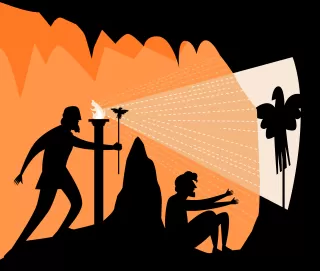
Plato´s Cave (matiasdelcarmine/Adobe Stock)
Life and thought processed by an AI-world
AI has now become sufficiently advanced and widely available that it has turned into a consumer good. As life in our societies has itself become a hyper-digital field, it was, in some sense, to be expected that digital devices would evolve to claim the last remaining traces of the human.
Thus, after having captured our attention and our capacity to concentrate – after we have allowed them to replace life with a kind of theatre of shadows -, we have deliberately entered the cave of Plato and have no desire to leave it. What we now witness is the substitution of the person, understood in the philosophical sense as a “space of identity,” by an algorithmic orchestration that manifests itself on the screens of what is (no longer quite) our life.
In the present moment, a myriad of discourses attempt to decipher the effects that this consumer-grade AI will have on our lives. To situate ourselves within this discourse, a prior distancing is required -one that proves useful for two distinct reasons:
First, any serious and well-grounded reflection on the effects of AI must avoid, at all costs, the impulse to contribute hastily to the generalized clamour that currently surrounds the topic, as though it demanded immediate comprehension and resolution. The prevalence of the “AI question” across mass communication, social media, and, indeed, within academic philosophy itself, should alert us to the risk of reflecting on AI while neglecting the very presuppositions of critical thought, which demands precisely this distance. The saturation of the topic, and the way in which AI has erupted and come to occupy such a significant portion of contemporary life, give rise to a sense of urgency – a kind of rush to think – that can only result in further noise and indistinction.
Second, only by resisting the urge to offer quick assessments of the present and future implications of AI is it still possible to identify, and then recover, the place that is genuinely human within a field defined by cybernetic socialisation and filled by experience regulated through algorithms.
If the first reason appeals merely to the demands of rigorous thinking, the second, paradoxically, hints at the grounds for our very sense of urgency, before the ominous novelty of consumer AI. We feel compelled to “resolve” and understand AI because systems and digital devices have come to occupy our experiential field. We sense that our individual identity is no longer something we can easily shape; our desires no longer arise from within; image and individual gain have become the regulators of our relations.
I would suggest that one of the most characteristic features of the present moment in the cohabitation between human beings and intelligent devices is the installation of a certain passivity in relation to a paradox. We all criticise AI, warning of its dangers and the uncertainty of the future – and even of the present. Yet at the same time, we all accept AI as a necessity imposed by technology, which, in the meantime, has come to direct the world. From business to leisure, from welfare to warfare.
Thus, we continue to criticise and to raise objections to the dominance of such “hyper-technology” within the sphere of life, while simultaneously fulfilling our role both as dispensers of content and as consumers, so that AI may proceed in constructing the totality of the experiential field .
And it does so with such efficiency that the result is a “personalised experience” shaped by the content presented to us. We all inhabit the same space, yet each of us sits before our own screens, consuming whatever the screen decides. This immersion of individuals within a shared public space is not governed by any idea of the progress of the species (which would require the widespread exercise of our critical and reflective faculties), but rather by an instrumentalisation of experience and individual consciousness in the service of profit and control.
Meanwhile, a certain unease begins to make itself felt – if we attend at all to the remaining trace of critical spirit we still possess. The unease of a loss of authenticity (a theme by no means new to philosophy) now appears not as the outcome of a long historical, political, or ideological process, but as something that descends upon us and settles rapidly. We feel, perhaps for the first time, the fear of losing our capacity to act as the producers of historical change. We sense – at the same time recognising that this may now be irreversible – that we have relinquished our role as agents of change within our civilisation.