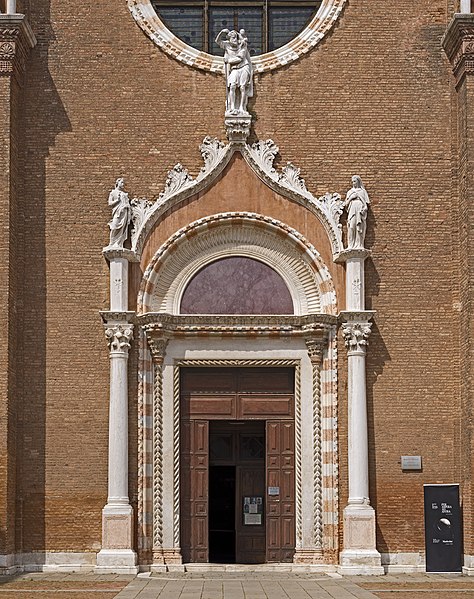
Venezia, Madonna dell'Orto
Serenity and separation
There are people for whom, due to a natural tendency in their character or through an arduous and successful path, they live life reaping its best fruit: serenity.
For the latter, the desire for a life free of mishaps and misunderstandings stems from the need to confront the irresolvable wandering that life is.
The entanglements that make life complex and sometimes unbearable are vast. The balance that is lost so easily, so quickly, only needs an imperceptible shift and it already falls apart. Sometimes, because we’re the ones who act against customs, morals, religion, and such kinds of order. At other times, because these dimensions show their true face, as human and all too human expressions.
We are the hand of the clock, which moves due to the action of a mechanism, but to which the time is pointed, pointing to the time imposed on it.
This path to serenity presupposes accepting that others are a vast and populous field without order or control. That’s what they and their emanations are for us, insofar as each of us is a traveller in a world full of changing forms and scenarios that are constantly informing us of something.
To achieve serenity, we therefore need to make an effort. We have to courageously admit that it’s impossible to find ourselves outside of ourselves. The unpredictability of the world, the lack of control not over, but of the others, is substantial to any self in front of its otherness.
The unpredictability of the others, for whom the demand for well-being must certainly be as similar and simple as the one we want for ourselves, destroys the construction of our own.
Men dedicate to the construction of order, in them lies the law that demands clarity and structure to give birth to science; they build the straight lines of skyscrapers while sowing disorder in the streets.
We go to bed full of plans and things to do tomorrow, searching for existential serenity with our fingertips, an arm stretched out as we fall asleep. Serenity is still but a mere image, a mere desire with no attainable body, but the object of such desire shares this moment with you, showing itself in the silence that happens between the inhales and exhales of your breath as your conscience fades.
Since this moment is unsustainable in time, some consolation is sought after through action. Even with clear and well-meaning intentions, the vigil, attentive to the world in order to cultivate inner harmony, often encounters first a wall, and then a siege. Disappointment reigns over those who expose their original innocence to the uncontrolled vileness of this inhabited world that is always outside and always close by.
The path is illuminated for those who courageously seek balance within breath. In a detachment that maintains curiosity, in the deep conviction that life is balanced between judgement and the suspension of judgement. It’s not uncommon for the restlessness of the spirit to reflect an activism in favour of values, when the value that something has for the subject doesn’t mean that there is any knowledge of it. In these cases, the impetus of the will to take possession of the fact, of the objective world, leads us into hierarchies and conflicts, opinions and debates, when the true spiritual richness of the fact lies not in its value but in its reception, first, and then in its knowledge.
The mind wants to welcome, perhaps out of selfish demand. It wants to take in the world, the others, the life that transcends it, and then withdraw, reflect and distance itself. That’s why serenity is neither entirely in the world nor entirely in the individual. It appears, if it appears, to those who understand that curiosity, openness of mind and giving oneself to the world is part of conquering oneself, inasmuch as its opposite, which is withdrawal, absence, silence and non-compliance, are exactly as necessary.
Either the bottomless abyss or the plain that stretches out pleasantly without borders. One side of life is unitary and concrete: what I do, what I’ve done, what I’ll do, expressions of my free-will. The other side is dual and elusive. The plain dissipates without warning and becomes an abyss, and the dark abyss, without explanation, begins to have ground as we get closer, firm ground where just now there was a vacuum, while the sun quickly chases away the shadows. Life is the game between the ‘this’ that I do and the ‘this or that’ of other people’s uncontrollability .
I can reach serenity of mind if I conquer myself within this question: what should I do, how should I act so that what I can decide on (my own freedom, which is action in potency) resolves itself peacefully in my consciousness, despite the world and its fantastical agitation?
To this impermanent world that grants me nothing, that entitles me to nothing but to accept volatility, the continuity of the consciousness that accesses it is the hallmark of the present. You may not be able to think everything through and predetermine what you feel, but you can believe in the distance between the self and the world, and you can even perceive yourself as innocent without needing someone to declare you so. Innocent as someone who suffers an injustice, or as someone who is carried away by an anomalous wave. Innocent as someone who recognises that others can hurt, even if they interpret their world with all the best intentions. And the closer you get acquainted with your innocence, the safer it is to cultivate serenity.
The continuity of experience in consciousness is the game of existence. To be more precise: not existence as such, as Being, but as individual beings. Everyone living in our times seems to be keen on grasping and living in the present. What does this ‘being present in the moment’ really mean? It means letting the random, uncontrollable world be assumed as such, and proclaiming our individual innocence in relation to it. Each of us is innocent to the extent that we are a consciousness for which the world of the others is uncontrollable. Knowing this, we can say that we live in the ‘present’, that is, that we live the indelible presence of the self and the indelible chaos of the others. This condition accompanies each of us to the end.
That world which gives us the opportunity to even pursue this desire, and which we now class as guilty, is the same one we need to infer our precious innocence.
To continually feel life as complete, so that you can die serenely at any moment. By consciously denying any expectation, the power of the uncontrollable dissipates like smoke from a fragile fire.
The depths of the “external uncontrollable” act in a similar way to the a priori forms of intuition in the philosophy of Kant. In Kant, the foundation of the transcendental subject is contrasted with the unfathomable ‘world-in-itself’, to which intuition and the categories offer intelligibility. For those who seek serenity, who know that it is a state and therefore dwells in the subject, the other and their disruptive power are also a ‘thing in itself’, alien in their substance, but present and in relationship with them.
To live in the awareness that life is greater than what happens to me, and at the same time more intimate than any event outside of me, keeps the world of the uncontrollable at a certain distance, so that in the space that opens up, the ‘categories of understanding’ can be applied, that is, acceptance that is not fully idle – rather, stoic – or the will to be serene. A categorical understanding, based on recognising your solitude in that dwelling that only you can inhabit, consciousness, and on the distance between consciousness and uncontrollability, which you take up in order to accept the fact and make it your spiritual possession.
Turn the face of your ambition towards yourself, when it becomes clear to you that so many are consumed by the effort involved in being recognised by others. In the uncontrollable thing that sometimes gives you guilt and abyss and that, often suddenly, presents you with good weather. In a moment, your set of beliefs and your reasonable expectations, your hopes, are dismantled, just for the slightest deviation in the interpretation of what you do or say. How can you make your connection to this chimera of inner serenity depend on throwing all your energy into a disorder that will never be tamed?
The distance between consciousness and fact is something that emerges with consciousness itself, and thus cannot be created by the individual, it cannot be produced by any intention. It is instead a gift that, like some other gifts that depend on this distance (views of nature, art, the whisper of someone you love, study), can only be explored if you, on your own, acquire a sense of what is at stake in it: the single that you will always remain in face of the fertile disunity of the world of otherness; the participation in that world – although aware of its inconsistency -; the autonomy to discover the value in facts, and not to assume the value with which facts are transported to you.
If not by natural inclination of the character, a serene life derives in large part from indifference to the disharmony we find in the world of humans, who only when coerced or when under illusions perform extraordinary feats. The conquest of serenity will always begin with the embrace of separation.